
SEO for Developers · Business Tips
Answer engine optimisation: the AEO guide
The whole method in one place: which question to pick, how to write the page so an engine can lift the answer, the fetch check, the trust that gets a page cited, and how to measure it. Nine questions, answered in order — and which deeper post to read next.

Answer engine optimisation in one paragraph
Answer engine optimisation is writing a page so an answer engine — AI Overviews, ChatGPT, Perplexity, Gemini — can lift the answer out and credit you: pick the question people type, put the answer first in 40–60 words that stand alone, prove it underneath, make sure the engine can fetch it, earn the trust that gets it cited, measure citations. On top of ordinary, honest SEO. With no special markup.
This is the long version, arranged as the nine questions people actually ask about it. Each section answers its question on its own and points to the post that goes deeper — What is AEO? for the definition and the six steps, What is AI SEO? for the tooling side, SEO vs AEO for the order things happen in, SEO vs AEO vs GEO — GEO being generative engine optimisation, the industry's third label — for Google's own words on it, and Best AI SEO tools for what to buy and when.
The method comes from hundreds of websites completed, and the measurement at the end is what my SEO team watches on every page written this way. When a page is cited for its question, the numbers go on the AEO post with their source.
How is AI changing SEO?
The basics haven't moved: a page still has to be indexed, fast and worth reading. Two things have changed — the unit of work, and the measurement.
The unit used to be a keyword and a page that ranked for it. Now it is a question and a page with one clear answer to it, because the engines that write answers take one passage and cite one source. A page that answers four questions loosely gets quoted for none. A page that answers one question directly gets quoted — and still ranks in the ordinary results, because the same directness helps a person.
The measurement used to be a position. For answer engines there is no position one; the number is whether your page is quoted, by which engine, for which question. That changes what a monthly report should contain, and it changes which tool is worth paying for. The tooling side — models reading audits into fix lists, drafting, grouping keywords — is a separate thing that people file under the same headline; What is AI SEO? untangles it. The short version: the tool is new, the judgement is not.
How to get your website cited by AI search engines
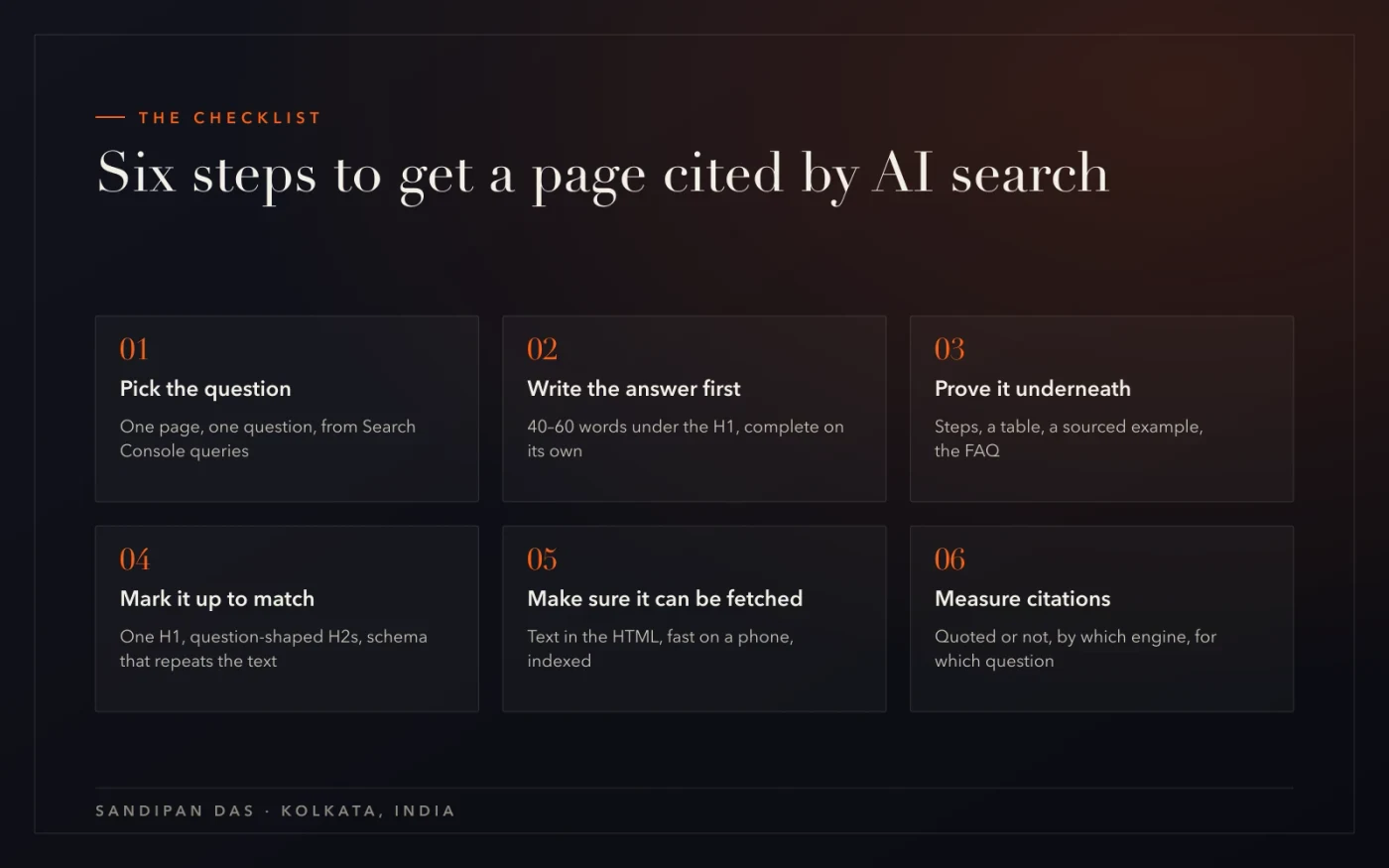
Six steps, in order — the checklist. Each has a full section in What is AEO?; this is the version to pin above the desk.
- Pick the question people actually type — Search Console → Performance → Queries, filtered to how / what / why / is. One page, one question.
- Write the answer first — 40–60 words under the H1, complete on its own — a stranger reading only that paragraph has the answer.
- Prove it underneath — Steps, a table, a real example with a sourced number, the FAQ of neighbouring questions.
- Mark it up to match the text — One H1, question-shaped H2s, FAQPage and Article schema that repeat what is visible — the schema generator writes the block.
- Make sure the engine can fetch it — Text in the HTML, fast on a phone, indexed — Search Console → Pages; the speed check covers the first two.
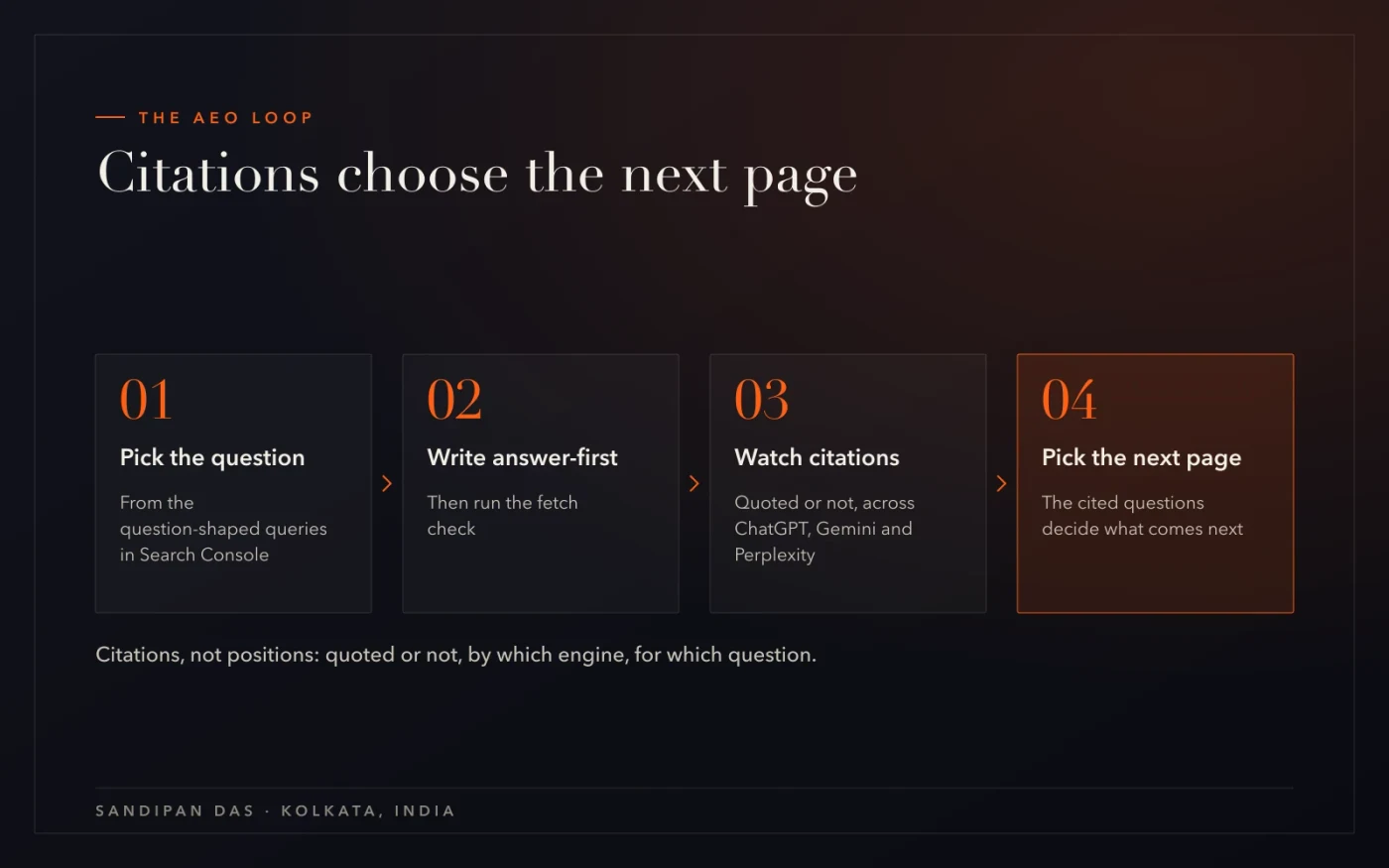
- Measure citations, not positions — Quoted or not, by which engine, for which question — and the cited questions choose the next page.
How to optimise content for Google AI Overviews
The same way you'd optimise for Google — because that is what Google says. Its own guide to the generative AI features is short, and I quote it rather than paraphrase from memory.
In Google's words and order, the points that matter:
- The AI features are "rooted in our core Search ranking and quality systems" — the ordinary signals underneath, no separate index.
- The page has to be crawlable, because the models use publicly accessible pages; if the site builds pages with JavaScript, the text has to exist without the script running.
- Content should be "helpful, reliable, and people-first" and not a commodity — a real perspective, real expertise. Structured data is not required for the AI features.
- Not to do: no llms.txt file, no special AI markup (Google Search doesn't need them), no chunking pages into fragments, no rewriting content specifically for AI systems — Google lists these as things you can ignore.
Read that against the six steps above and nothing conflicts. The answer-first rule isn't a hack; it is a page that is better for the person reading, and the engine is reading over their shoulder. Follow-up questions in Google's AI Mode can draw on the same sources, which is one more reason to answer the one question completely. The full reading of the guide, with the three labels, is in SEO vs AEO vs GEO.
How to optimise content for ChatGPT search
There is no submission form and no special tag. ChatGPT reads the open web and cites the page that answers most directly — so the page that wins is the answer-first page that any engine can fetch.
Three things matter more here than for Google's own features. First, the fetch: ChatGPT's reading of a page is a plain one, so the text has to be in the HTML and the page has to load without a wait — a page that renders its words with JavaScript after the fact may as well be blank. Second, the answer has to be self-contained, because the engine is composing a reply from several pages and quotes the passage that needs no context. Third, the page needs a reason to be trusted over the others it read — a named author, a source on every number, one real example. That third point is the whole of the E-E-A-T section below.
My approach is one page, written for a careful person, rather than a second version "for ChatGPT". That one page is the version every engine wants; Google says as much in its own guide, and what I've seen from the others agrees with it.
How to optimise content for Perplexity
Perplexity shows its sources next to the answer, so it is the place where you can see the method working or not — and the same answer-first page wins.
Type the question your page answers and look at which pages it names. If yours isn't there, the reasons are almost always the ordinary ones: the page isn't indexed, the answer is buried under a preamble, or the page makes a claim with no source and the engine chose a page that showed its working.
For Perplexity I use the same checklist as above:
- The answer block tight and checkable — the passage an engine lifts is the one that needs no context.
- Every number sourced — a claim with a source is what a careful reader, and an engine imitating one, prefers.
- The page current — the question and answer at the top, the updated date honest.
Same page, checked in a place where you can see the result.
How to audit a website for AI search
Run the ordinary audit first, because an engine can't cite what it can't fetch — then check each important page for the answer block and the proof. The order is the ladder in SEO vs AEO.
The first pass is free: the SEO checker, the speed check and the robots & sitemap checker on this site list the basics — not indexed, text behind JavaScript, two H1s, a sitemap full of redirects — and Search Console → Pages says what Google has actually listed. Nothing above this rung matters until it holds.
The second pass is page by page, and only for the pages that already get visits: does the page answer one question; is the answer in the first 60 words and complete on its own; is there proof under it — steps, a table, an example with a source; does the FAQ on the page match the FAQPage schema; is there a named author. The third pass is the citation check for those pages, in the measurement section below. A tool can list the issues from the first two passes; a person picks the three pages to fix first, because the order has to know the business.
Does E-E-A-T matter for AI search?
Yes — it is most of what gets one page cited over ten similar ones. E-E-A-T is Google's shorthand for experience, expertise, authoritativeness and trust; for an engine choosing a source it looks like the tests a careful reader runs.
Who wrote this, and what have they done — a named author with a page of their own and a record you can check. Where do the numbers come from — a source and a year on each, or no number. Is there a real case, or only general claims. Does the page admit what it doesn't cover. An engine that has read ten pages on a topic can tell the one that shows its working from the nine that assert; so can a person.
This is also why GEO — generative engine optimisation — sits so close to AEO: what it names is AEO plus these trust signals, and the signals are slow, ordinary work. The same team, the same page, and the part that compounds: the next page inherits the author's credibility. SEO vs AEO vs GEO takes the three labels apart.
How to make content more trustworthy for AI search
Four things, none of them markup: a named author with a page, a source on every number, one real example, and a plain line about what the page doesn't do. A person checks all four before the page goes live.
- A named author with a page. Not "admin", not the company. A person, with an about page that says what they've built and for whom, linked from every post. The author box at the bottom of this page is the pattern.
- A source and a year on every number. "Studies show" is not a source. If the number can't be traced, cut it — a page with three sourced numbers beats a page with thirty unsourced ones, to an engine and to a reader.
- One real example, or the honest "none yet". A case with what was wrong, what changed and the before-and-after — with consent to name the client, or anonymised. Where there isn't one, say so; a page that admits it is more trustworthy than a page that invents one.
- What this page doesn't cover. A line about the limits — who this isn't for, what it doesn't do — is the sentence a reader checks for. It costs nothing and it reads as a person.
How to measure AI search visibility
By citations, not positions: for each page and its question, is the page quoted as a source, by which engine, and how often — read next to the question-shaped queries in Search Console.
For each page you've written answer-first, the check is the same: the question typed into an AI Overview, into Perplexity, into ChatGPT — is the page named. My SEO team runs that across ChatGPT, Gemini and Perplexity with the AI-visibility check in DevsKing, the SEO tool company I founded, and reads Search Console beside it: the queries starting with how, what and why, and whether they grow for the pages that were rewritten. Monthly, in plain words — the same report the SEO services page promises.
What the measurement is not: a position, a score, or a promise. No engine has a position one, and a citation is the engine's choice; my team does the work and watches it. When a page is cited for its question and the numbers are worth showing, they go on the AEO post with their source.
What people get wrong about answer engine optimisation
Across the five posts these four came up most, so they are the four to check a proposal against.
- Buying AEO or GEO as a product. A page that isn't indexed can't be quoted; a new file or tag doesn't change that. Google says it ignores the special markup — and most of the hacks.
- Burying the answer. Four hundred words of "in today's digital landscape", then the answer. The engine quotes the first plain sentence it finds, which is the wind-up.
- Chasing tools before the basics. Connect Search Console, fix the fetch, then decide whether a paid suite earns its place — the order in Best AI SEO tools.
- Measuring citations with rankings. Positions are the SEO number. For AEO the number is quoted or not, and a good report shows each under its own name.
Which post to read for what
The five posts this guide sits on, and the one question each answers.
| If you want | Read | In one line |
|---|---|---|
| The definition and the six steps | What is AEO? | The answer first; the rest of the page proves it |
| The tooling side, untangled | What is AI SEO? | The model drafts, the person decides |
| The order things happen in | SEO vs AEO | Do the SEO, then put the answer first |
| Google's own words on it | SEO vs AEO vs GEO | Three names, two extra rules, one page |
| What to buy, and when | Best AI SEO tools | Buy the list, never the order |
One question, answered first, proved underneath, by a named person — then watch whether it's quoted. Everything else in answer engine optimisation is ordinary, honest SEO.
Read next
The five posts, in publishing order, then the services and the tools this guide uses.
- What is AEO? — answer engine optimisation, explained
- What is AI SEO? — two meanings, one honest answer
- SEO vs AEO — one page, one extra rule
- SEO vs AEO vs GEO — three names, one page
- Best AI SEO tools — how to choose, in three tiers
- SEO services — done for you
- Freelance SEO consultant — the plan
- Free SEO checker
If you'd rather have someone run the loop
Run the free SEO checker on the page you'd most like to be quoted — it tells you which rung you're on before anything is rewritten. If you'd rather have a team pick the questions, write the pages answer-first and report the citations monthly, the SEO consultant page is the plan and SEO services is the team doing it.
Questions
Questions this post answers
What is AEO?
- Answer engine optimisation: writing and structuring a page so that an answer engine — Google's AI Overviews, ChatGPT, Perplexity, Gemini — can lift the answer straight out of it and credit your site. The one rule is the answer first, in 40–60 words that stand alone, with the proof underneath; the rest is ordinary honest SEO.
What is AI SEO, and is it the same thing?
- No. AI SEO usually means using AI models to do SEO work faster — reading an audit into a fix list, grouping keywords, drafting — which is a tooling choice. AEO is a writing rule about where the answer sits. The two often share one label, so it helps to ask which one is meant.
SEO vs AEO — which comes first?
- SEO, always: a page has to be indexed, fast and worth reading before any engine will quote it. AEO is the fourth rung on that ladder, not a replacement for the first three. Judge SEO by positions and clicks, AEO by whether the page is cited.
Which AI SEO tools should a small business buy?
- In order: Google's free tools first (Search Console, PageSpeed Insights, the Rich Results Test), free one-job checkers second, and a paid AI-assisted suite only once the basics are fixed — and only if a person reads what it produces. The tool drafts the list; a person still chooses the order.