
SEO for Developers · Business Tips
What is AI SEO?
"AI SEO" means two different things, and most of the confusion comes from mixing them up: AI doing the SEO work, or AI engines quoting your site. This post is about the first — what a model is good for, where a person still decides, and the pattern I build on.

What is AI SEO, and what it isn't
What is AI SEO? AI SEO means one of two things: using AI models to do SEO work faster — reading an audit into a fix list, grouping thousands of keywords into topics, writing first drafts — or writing pages so that AI answer engines quote your site, which has its own name, AEO (answer engine optimisation). The first is a tooling choice. The second is a writing rule. Knowing which one a page needs tells you what to ask for.
So what is AI SEO for a business owner deciding whether to buy it? It is the same SEO work your site needed last year, with the slow parts done by a model and the decisions still made by a person. The audit still has to be read; the priorities still have to be set; the page still has to say something true about your business. What changes is how fast the first draft of each of those arrives. I use AI for SEO every working day, and I'd still put it that plainly.
The second meaning — being quoted by Google's AI Overviews, ChatGPT or Perplexity — is covered in What is AEO?. This post stays on the first.
Where a model actually helps in SEO work
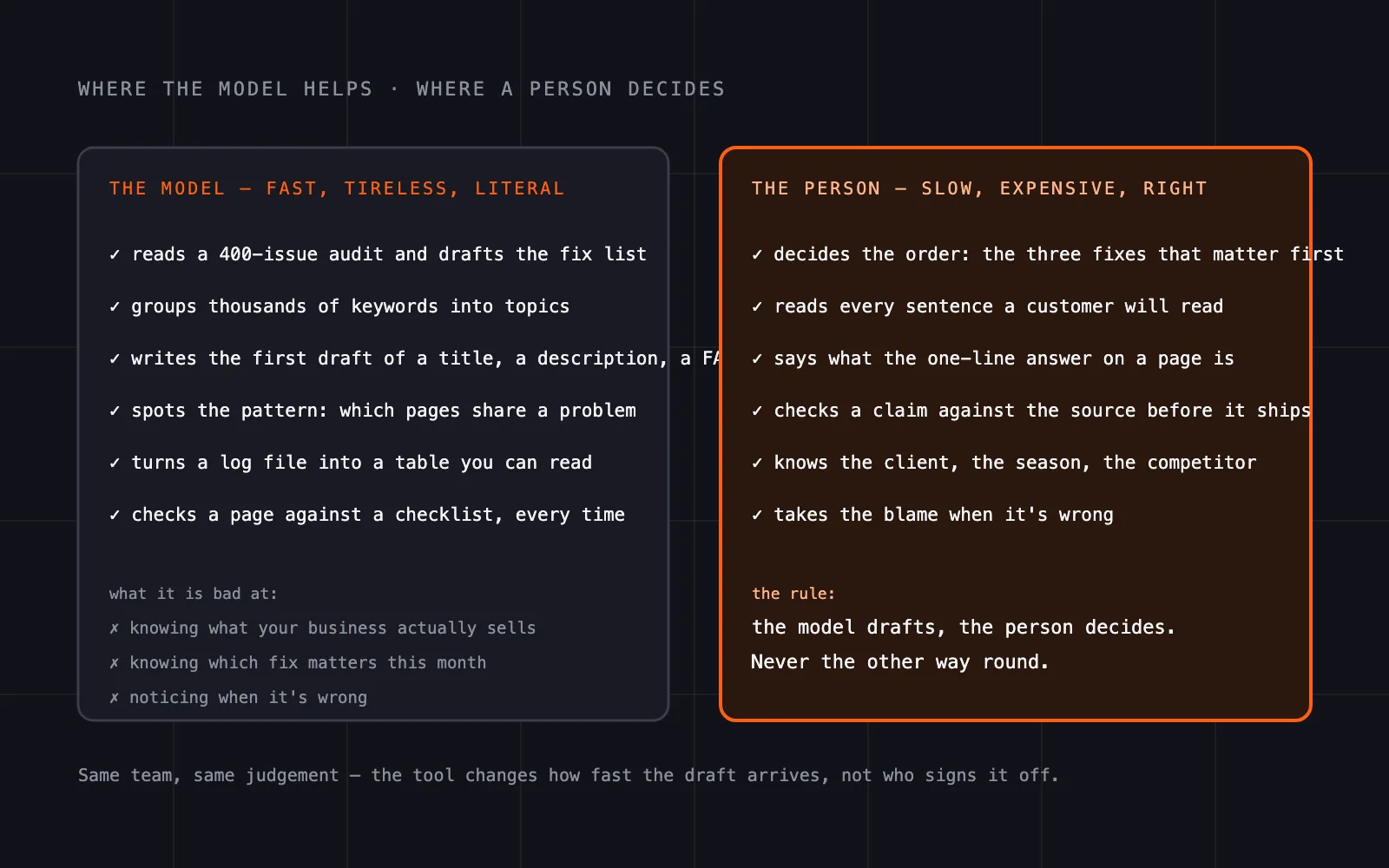
A model is fast, tireless and literal. That makes it good at the parts of SEO that are long and boring, and bad at the parts that need to know your business. I split it the way my SEO team does with the AI SEO tools we build and use:
The pattern on the left is drafting and sorting. An audit tool finds hundreds of issues; a model turns them into a short fix list a person can read. A keyword export with thousands of rows becomes a handful of topics. A page needs a title, a description and five FAQ answers; a model writes the first version of each, and a person rewrites the half that's wrong.
The pattern on the right is judgement. Which handful of those issues matter this month. Whether the one-line answer on the service page is actually what the business sells. Whether a claim the draft made is true. Whether a customer will read this sentence and trust it. None of that is a model's job, so on my team a person does it, every time.
The five-part pattern that makes AI safe to use
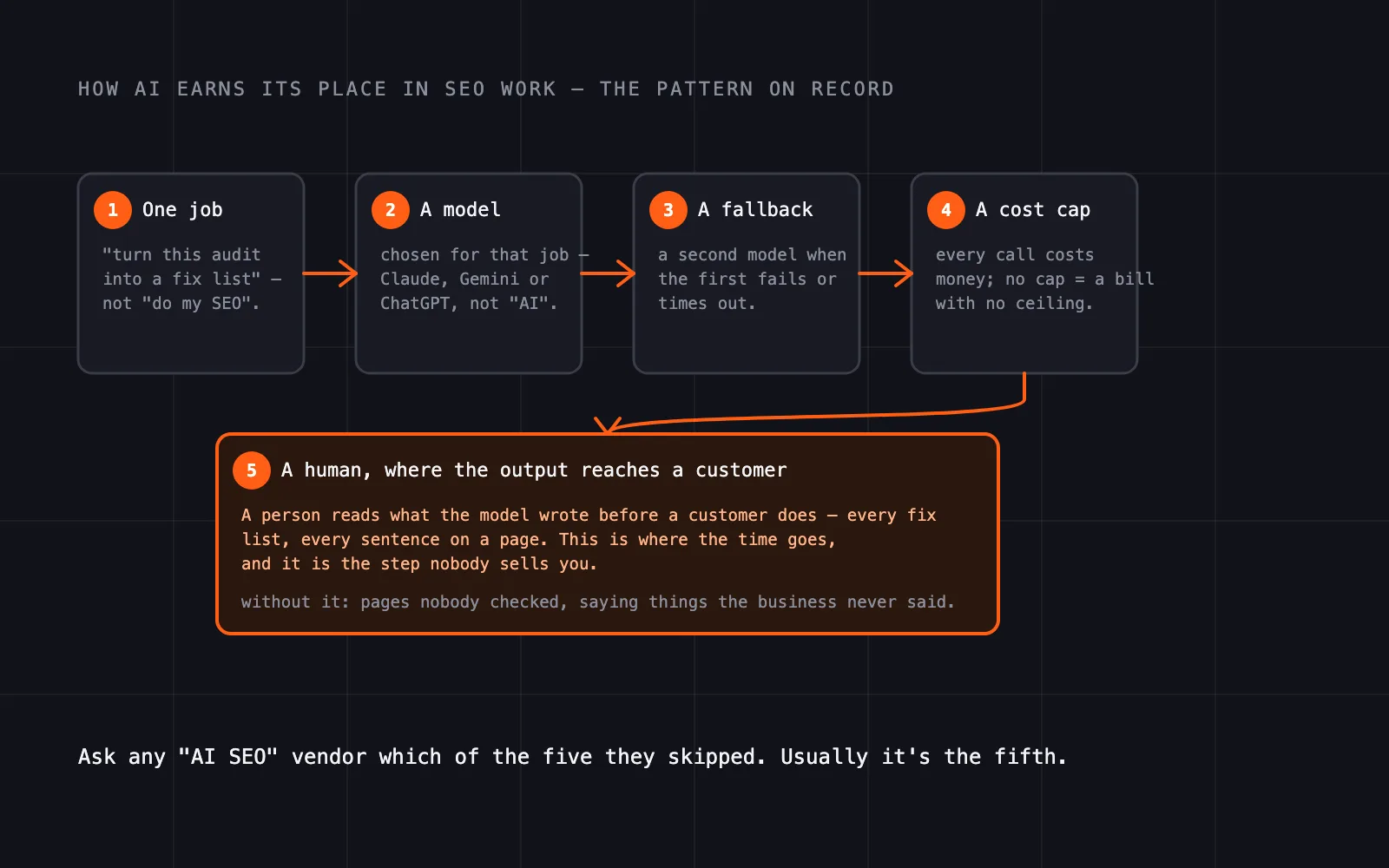
Every AI feature I've shipped into an SEO tool has the same five parts, and the fifth is the one I spend the most care on. This is how DevsKing, the SEO tool company I founded, is built on Claude, Gemini and ChatGPT — and it is the checklist my team builds every AI SEO feature to.
- One job — "Turn this audit into a fix list." "Group these keywords." Not "do my SEO". A model with one scoped job can be checked; a model with a vague one can only be trusted, and trust is not a process.
- A model chosen for that job — Claude, Gemini or ChatGPT — picked per task, not "AI" in general. They differ in what they're good at, what they cost and how they fail. The choice is part of the build, made for each task.
- A fallback — Models time out, get rate-limited and go down. A feature that has no second model behind the first stops working on the day you need it. The fallback is boring and it is not optional.
- A cost cap — Every model call costs money. A feature without a ceiling on calls per day is a bill with no ceiling — and it runs away on the day a client bulk-publishes.
- A human, wherever the output reaches a customer — A person reads what the model wrote before a customer does — every fix list, every sentence on a page. This is where the time goes and where the quality comes from. On my team, you always know which person read the output.
The honest part: what the tools change, and what they don't
A ranking or a traffic number comes from the work on the page, with AI speeding up the drafts along the way. A model doesn't rank a page. The work ranks a page: the indexing fixed, the answer written, the site fast. What the model changes is how long the draft of each step takes to arrive, and how much of the boring part a person has to do by hand.
What I can say is what the tools change: an audit arrives as a fix list in plain English instead of a spreadsheet, and the hours a person spends go on deciding rather than reading. The deciding was always the job. The reading was the tax on it.
What I'd tell a client honestly: the review step is where the hours are. Reading what the model wrote takes longer than people expect, because it reads well and is wrong in small ways — a claim the business never made, a number with no source, a confident sentence about a competitor. Budget for the reading. It is the work.
What to get right about AI SEO, so people trust the result
Four things I check first when a site comes in for an audit, and the fix for each.
- Read AI-generated content before it goes live. A page published without a read-through can say things the business never said. Google's guidance on generative-AI content judges the result, not the tool — helpful, reliable, original, made for people — and calls automation used mainly to manipulate rankings spam. The tool is fine; the reader is what makes the page safe.
- The basics before AI SEO tools. A site that isn't indexed, loads its text with JavaScript, or takes six seconds on a phone gets nothing from a model. The free SEO checker on this site lists the basics; fix those first.
- A person sets the priorities. SEO automation is good at listing: an audit lists hundreds of issues. The order is the job, and it needs someone who knows the business, the season and the competitor. If the tool decides, you've hired the tool.
- AI SEO and AEO are two different jobs. Automating the work is one thing; being cited by an answer engine is another, with its own rule — the answer first, then the proof. Different problem, different post.
AI SEO vs AEO: two meanings, side by side
If you take one thing from this post: know which of these two a page needs. The left column is the tooling, the right is the writing rule, and each one does a different job.
| What changes | AI SEO (the tooling) | AEO (the writing rule) |
|---|---|---|
| What it is | Models doing SEO work faster | Pages written so answer engines cite them |
| Who it's for | The team doing the work | The reader — and the engine reading over their shoulder |
| What it changes | How fast a draft or a list arrives | Where the answer sits on the page |
| What it doesn't change | What ranks: the work, checked by a person | The basics: indexed, fast, honest |
| The risk | Unread output published as fact | Markup promising answers the page doesn't give |
| How to buy it | Ask who reads the output | Ask to see the answer block on a page they wrote |
The model drafts. The person decides. Never the other way round — and if you can only automate one thing, automate the reading of the audit, never the choosing of what to fix.
Read next
The other meaning, the services this belongs to, and the tools from the steps.
- What is AEO? — answer engine optimisation, explained
- SEO services — done for you
- AI automation — the five-part pattern, built into your product
- Freelance SEO consultant — the plan
- Free SEO checker
- Keyword & content analyzer
If you'd rather have someone do this
Run the free SEO checker on the page that earns you the most, then bring the result to a call. My team and I have hundreds of websites completed, and we'll tell you where the page stands. If you'd rather have a team that uses the tools and still reads every line, that's what I do — the SEO consultant page says how, and SEO services is the done-for-you version. The whole method, all nine questions, is in the AEO guide.
Questions
Questions this post answers
How do you optimise content for ChatGPT search?
- The same way as for any answer engine: one question per page, the answer in the first 40–60 words standing on its own, the proof underneath, and a page that is indexed, fast and readable without JavaScript. There is no separate submission for ChatGPT; it reads the open web and quotes the page that answers most directly.
How do you optimise content for Perplexity?
- Perplexity cites sources next to its answers, so the page that gets cited is the one with a clear, self-contained answer and visible proof — steps, a real example, numbers with their source. Write answer-first, keep the claims checkable, and make sure the page is indexed; the rest is the same honest SEO.
How do you audit a website for AI search?
- Start with the ordinary audit — indexing, speed, text in the HTML, one H1 per page — because an engine can't cite what it can't fetch. Then check each important page for a direct answer at the top and proof below it, and whether the schema (the hidden markup that describes the page to search engines) repeats what is visible. A tool can list the issues; a person decides which page to fix first.
How do you make content more trustworthy for AI search?
- The signals are the ones people use: a named author with a track record, numbers with a source and a year, a real example, and a page that states its scope plainly. On my team a person reads every AI-drafted line before it is published, so the page earns that trust from the reader, human or engine.