
SEO for Developers · Business Tips
SEO vs AEO
They are not rivals, and you don't choose between them. SEO is the work that gets a page found and read; AEO is one extra rule on top so an answer engine can quote the page. Which comes first, how each is measured, and how the two fit together on one page.

SEO vs AEO in one paragraph
SEO vs AEO comes down to this: SEO — search engine optimisation — is the work that makes a page findable and worth reading: indexed, fast, honest, linked to. AEO — answer engine optimisation — is one rule added on top: the answer first, in 40–60 words that stand alone, then the proof, so an answer engine can quote you. You do the first and add the second. The second always stands on the first.
I've written the long version of each — What is AEO? and What is AI SEO? — so this post does the one thing those don't: put them side by side, in the order they have to happen, with the number each one is judged by. If you're deciding what to pay for, that order is the whole decision.
Same page, two readers
The clearest way I've found to explain SEO vs AEO is that they are two readers of the same page, and the page doesn't change. The search crawler reads all of it: can it fetch the page, is it fast, does it have one H1 and real headings, who links to it, is it worth reading. From that it decides where the page ranks for a query.
The answer engine reads the same page and then takes one block: the passage that answers the question most directly. If that block is the first thing under the H1, complete on its own, with the proof underneath, the engine can quote it and name the site. If the answer is buried after four hundred words of wind-up, the engine quotes the wind-up — or somebody else's page.
Everything the crawler wants, the answer engine wants too. A page it can't fetch, it can't quote. That is why the order below isn't a preference; it's how the two readers work.
Which comes first: the ladder
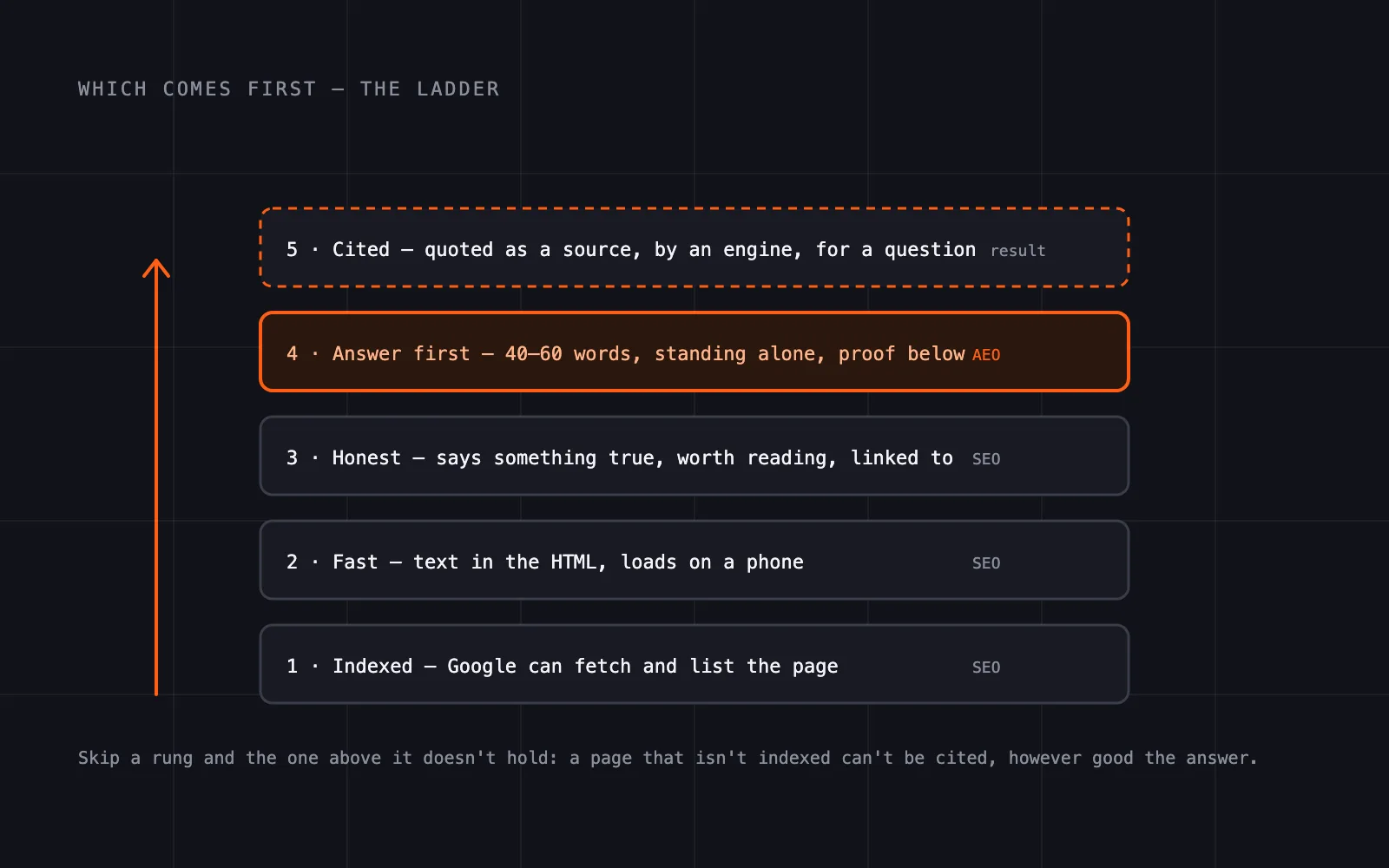
Four rungs of SEO, one rung of AEO, and the result on top. Skip a rung and the one above it doesn't hold. This is the order I run on any page a client wants quoted.
- Indexed — Google can fetch the page and has listed it — Search Console → Pages tells you. A page that isn't indexed cannot rank and cannot be cited, however good the answer. When a page isn't being quoted, this rung is the first place I look.
- Fast, with the text in the HTML — The words are in the page the server sends, not painted in by JavaScript afterwards, and the page loads on a phone without a wait. The free speed check covers both. An engine's first fetch is a plain one.
- Honest and worth reading — The page says something true about the business, in its own words, with a real example or a number that has a source. This is the rung that takes the longest and the one that needs a person who knows the business — and it is where both readers decide whether to trust you.
- Answer first — the AEO rung — Under the H1: the answer, 40–60 words, standing on its own — no "it" pointing back, no "as we'll see below". Then the proof: steps, a table, the example, the FAQ. One page, one question. The schema generator writes the FAQPage block once the FAQ is on the page.
- Cited — the result — Quoted as a source, by which engine, for which question. Not a rung you climb; the thing the ladder is for. Measured, not promised.
How each one is measured
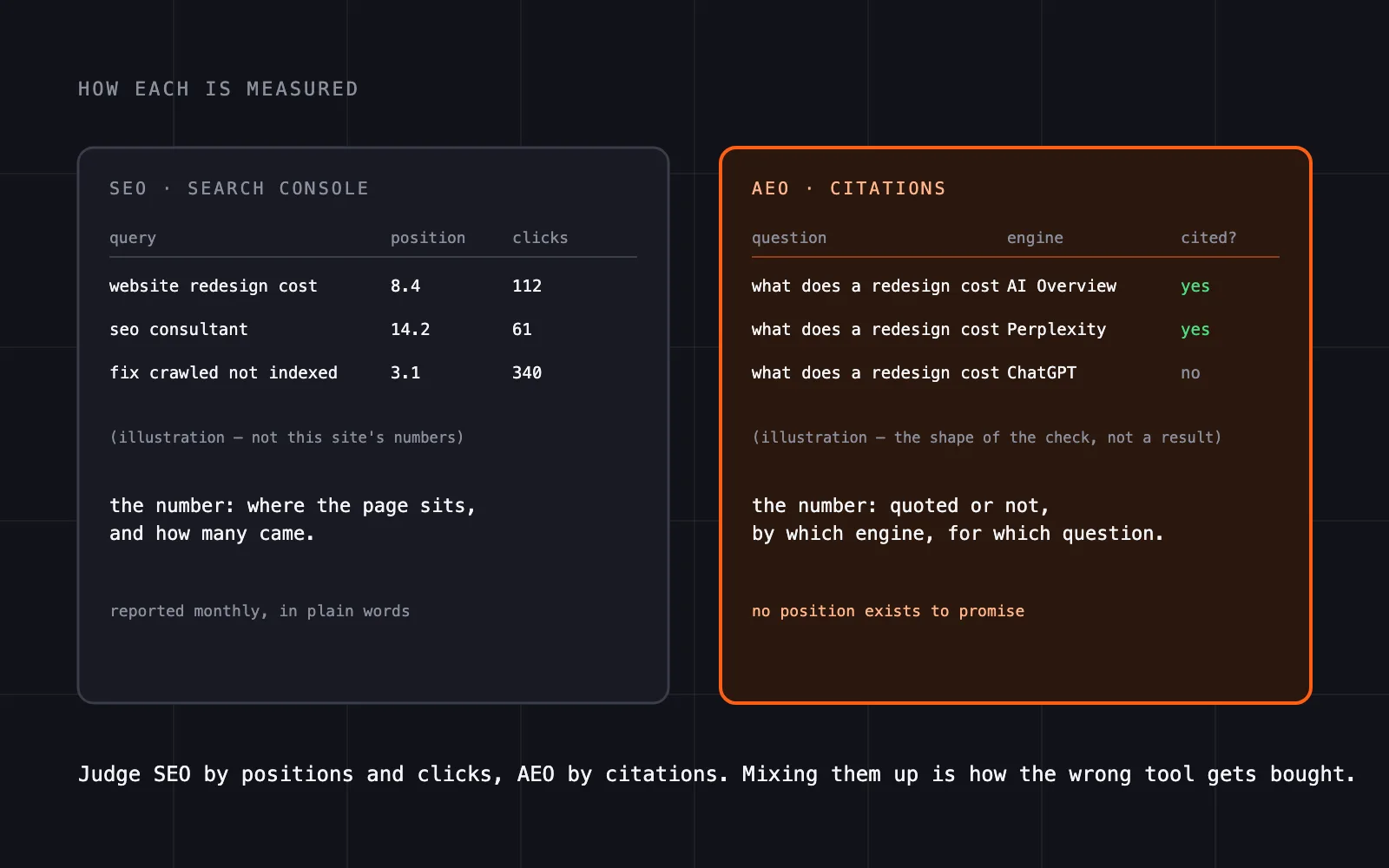
SEO is judged by positions and clicks. AEO is judged by citations. So each one gets its own report. For SEO the number lives in Search Console: where a page sits for a query, how many people came, month on month. The team reports that in plain words, monthly — it's the same report the SEO services page promises.
For AEO there is no position to promise, because an answer engine doesn't have ten places. The number is whether the page is quoted, by which engine, for which question — the check the team runs across ChatGPT, Gemini and Perplexity alongside Search Console. A page can be cited and rank eleventh. A page can rank first and never be cited. They are different questions about the same page.
I'll say the honest part once, as I did in the AEO post: every citation result is reported against the page and the engine it came from, with its source. What I can tell you takes longer than anyone expects is the rung before the measurement — agreeing, page by page, what the one-sentence answer actually is. Clients approve a thousand words about their service quickly and give far more care to the fifty that say what it is. That conversation is the work.
What to get right about SEO vs AEO, so people quote you
Four things to get right, in the order I check them.
- SEO first, then AEO. A page that isn't indexed can't be quoted. The first three rungs give the fourth something to stand on.
- Measuring AEO with citations. An answer engine has no position one. So the AEO report counts citations, and the SEO report counts positions.
- Rewriting pages answer-first in order of traffic. Start with the five pages that already get the most visits; those are the ones an engine already reads. The rest can wait, and some can wait forever.
- A featured snippet and an AI Overview are one job. The same block wins both: the direct answer at the top, proof underneath. One rewrite, two readers.
SEO vs AEO, side by side
If you only read the table: same team, same page, one extra rule, a different number to watch.
| What changes | SEO | AEO |
|---|---|---|
| The job | Get the page found and read | Get the answer quoted |
| The unit | A page and its queries | A page and its one question |
| What it touches | The whole page and the site around it | The first 60 words and the proof below them |
| Measured by | Positions, clicks, impressions | Cited or not, by which engine, for which question |
| Can be promised? | Improvement, never a position | Neither — measured, not promised |
| Comes first? | Yes — rungs one to three | After — the fourth rung |
| Who does it | The same team | The same team |
Do the SEO. Then put the answer first. SEO is the house; the answer-first block is the roof that sits on it.
Read next
The two long versions, the services this belongs to, and the tools from the ladder.
- What is AEO? — answer engine optimisation, explained
- What is AI SEO? — two meanings, one honest answer
- SEO services — done for you
- Freelance SEO consultant — the plan
- Free SEO checker
- Free speed check
If you'd rather have someone do this
Run the free SEO checker on the page you'd most like quoted — it tells you which rung you're on. If you'd rather hand the ladder to a team with hundreds of websites completed, who report the numbers monthly, start with the SEO consultant page; SEO services is the version where the team does the climbing. The whole method, all nine questions, is in the AEO guide.
Questions
Questions this post answers
How is AI changing SEO?
- The basics haven't moved: a page still has to be indexed, fast and worth reading. What changes is the unit of work — from a keyword to a question with one clear answer — and the measurement, from a position to whether the page is quoted. Sites that already wrote for people have the least to change.
How do you get your website cited by AI search engines?
- Climb the ladder in order: indexed, fast with the text in the HTML, honest and worth reading — then put the answer to one question in the first 40–60 words and prove it underneath. The engines quote the page that answers most directly, not the page with the most words.
How do you measure AI search visibility?
- By citations rather than positions: for each page and its question, is the page quoted as a source, by which engine, and how often. The team runs that check across ChatGPT, Gemini and Perplexity and reads the question-shaped queries in Search Console next to it.
Does E-E-A-T matter for AI search?
- Yes — an engine only quotes pages it has reason to trust, and it borrows the reader's tests: is there a real person behind it with a track record, does the page show its working, does it admit what it doesn't cover. Rungs one to three of the ladder build exactly that; the answer-first rung only decides which passage gets lifted.