
SEO for Developers · Business Tips
SEO vs AEO vs GEO
Three names for one piece of work with two extra rules: SEO makes the page findable, AEO puts the answer first, GEO is being the page a generative engine trusts enough to cite. What each changes, what Google says, and why a three-line quote needs a question.

SEO vs AEO vs GEO in one paragraph
SEO vs AEO vs GEO: SEO makes a page findable and worth reading. AEO adds one rule — the answer first, standing alone, then the proof — so an answer engine can quote it. GEO, generative engine optimisation, is being the page a generative engine trusts enough to cite: AEO plus a named author, sourced numbers, a real case. One page. Two extra rules. Three names.
The generative engines are Google's AI Overviews and AI Mode, ChatGPT, Perplexity and Gemini. "Trust", to them, looks like it does to a careful reader: who wrote this and what have they done, where do the numbers come from, is there a real case, does the page admit what it doesn't cover.
The order matters more than the names. I'd put it this way: the third is built on the first two, and every engine reads all three on the same page. Google says as much in its own guide, which I quote below rather than paraphrase from memory.
Three labels on one page
Put the three labels on a real page and the argument disappears: SEO is the whole page, AEO is the block at the top, GEO is the trust drawn around it. Nothing in the third label is a new thing to build; it is a description of a page the other two already made.
SEO covers everything both engines and people need before they'll spend time on the page. It's fetched, it's fast, the text is in the HTML, it has one H1 and real headings, other pages link to it, and it says something true. This is where most of the hours go, and where the work pays off most. The long version is in What is AEO? and SEO vs AEO.
AEO is the first 60 words: the answer to the page's one question, complete on its own, with the proof underneath. GEO is what makes an engine pick *your* answer over the ten others it read. Who wrote it and what they've done. Whether the numbers have a source. Whether there's a real example. Whether the page admits what it doesn't cover. I check the same things before I trust a stranger's advice; the engines are, at bottom, imitating that.
What Google's own guide says about AI features
Google published a guide to appearing in its generative AI features — AI Overviews and AI Mode — and it is short and plain. I read it on 20 September 2026; it was last updated in July. The points that matter, paraphrased closely:
I read that against the three labels and every point is an SEO point or a trust point. Google doesn't ask for a new file, a new tag or a rewrite for the machine. The AEO rule survives because it isn't a hack. An answer that stands on its own is better for the person reading; the engine is reading over their shoulder.
- The AI features are "rooted in our core Search ranking and quality systems" — Google's words. Ordinary signals underneath; no separate index.
- Content has to be crawlable, because the models use publicly accessible pages. If the site builds its pages with JavaScript, follow Google's JavaScript SEO practices — in plain terms, make sure the text exists without the script running. Give a good page experience on every device.
- Write "helpful, reliable, people-first" content that isn't a commodity: a unique perspective, real expertise.
- Structured data is not required for the AI features. Keep using it for rich results.
- Don't create llms.txt files or special AI markup — Google Search ignores them. Don't chunk pages into fragments. Don't rewrite content specifically for AI systems. Ignore most of the "AEO" and "GEO" hacks circulating online.
How I run it: the order on a real page
Same team, same page, in this order — and the third step is where the slow, compounding work is. No step needs a new tool; the last one needs a person who knows the business.
- SEO: make it fetchable, fast and honest — Search Console → Pages says whether it's indexed. The free SEO checker and speed check list the basics. Then the part that takes time: the page says something true, in the business's own words.
- AEO: put the answer first — One question per page; the answer in the first 40–60 words, standing alone; proof underneath — steps, a table, a real example, an FAQ. The schema generator writes the FAQPage block from the questions that are actually on the page.
- GEO: earn the trust signals — A named author with a page of their own and a track record; every number with a source and a year; one real example; a plain line about what the page doesn't cover. Slower than any markup, and the only part that compounds — the next page inherits the author's credibility.
- Measure citations, not positions — The team checks whether the page is quoted, by which engine, for which question — across ChatGPT, Gemini and Perplexity, next to Search Console. Each result is reported against the page and the engine it came from, with its source.
What to get right about SEO vs AEO vs GEO, so people trust the page
Four things to get right, in the order I check them.
- GEO needs no new markup and no "GEO plugin". Google's guide says so: no llms.txt, no special AI tags. The work happens in the page itself.
- Label one first, before the other two acronyms. If the page still loads its text with JavaScript, fix that first. Labels two and three are built on label one.
- Writing for the reader, and the engine follows. "Don't rewrite content specifically for AI systems" is Google's line, not mine. The page written for a careful person is the one both readers trust.
- Generative engines and AI SEO tools are different things. A generative engine is where the answer appears — AI Mode, ChatGPT. An AI SEO tool is something that helps you do the work — a different post, and a different bill.
SEO vs AEO vs GEO, side by side
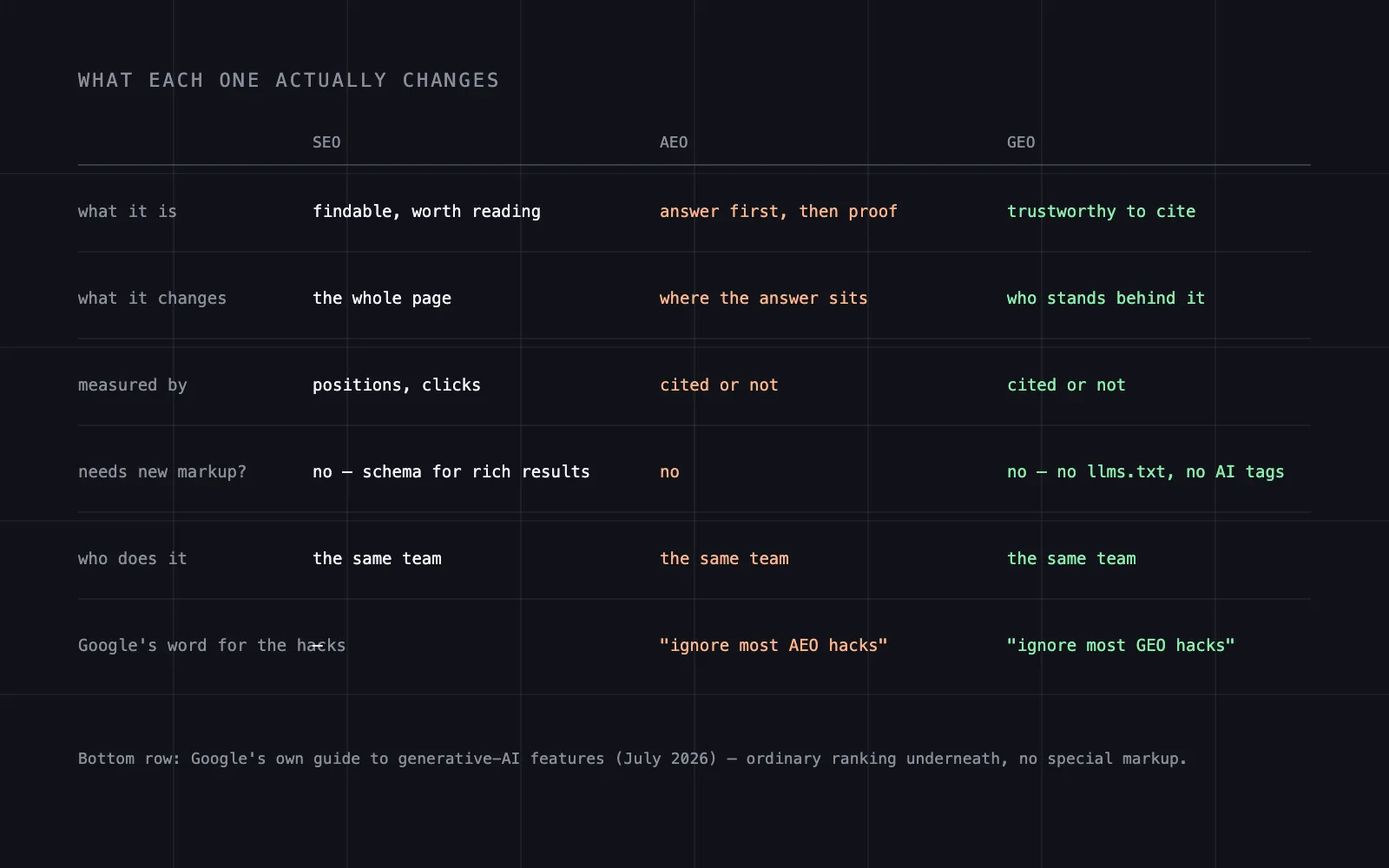
If you only read the table: same team, one page, two extra rules, and the bottom row is Google's, not mine.
| What changes | SEO | AEO | GEO |
|---|---|---|---|
| What it is | Findable, worth reading | The answer first, then proof | Trustworthy enough to cite |
| What it changes | The whole page | Where the answer sits | Who stands behind it |
| Measured by | Positions, clicks | Cited or not | Cited or not |
| Needs new markup? | No — schema for rich results only | No | No — no llms.txt, no AI tags |
| Who does it | The same team | The same team | The same team |
| Google's word for the hacks | — | "ignore most AEO hacks" | "ignore most GEO hacks" |
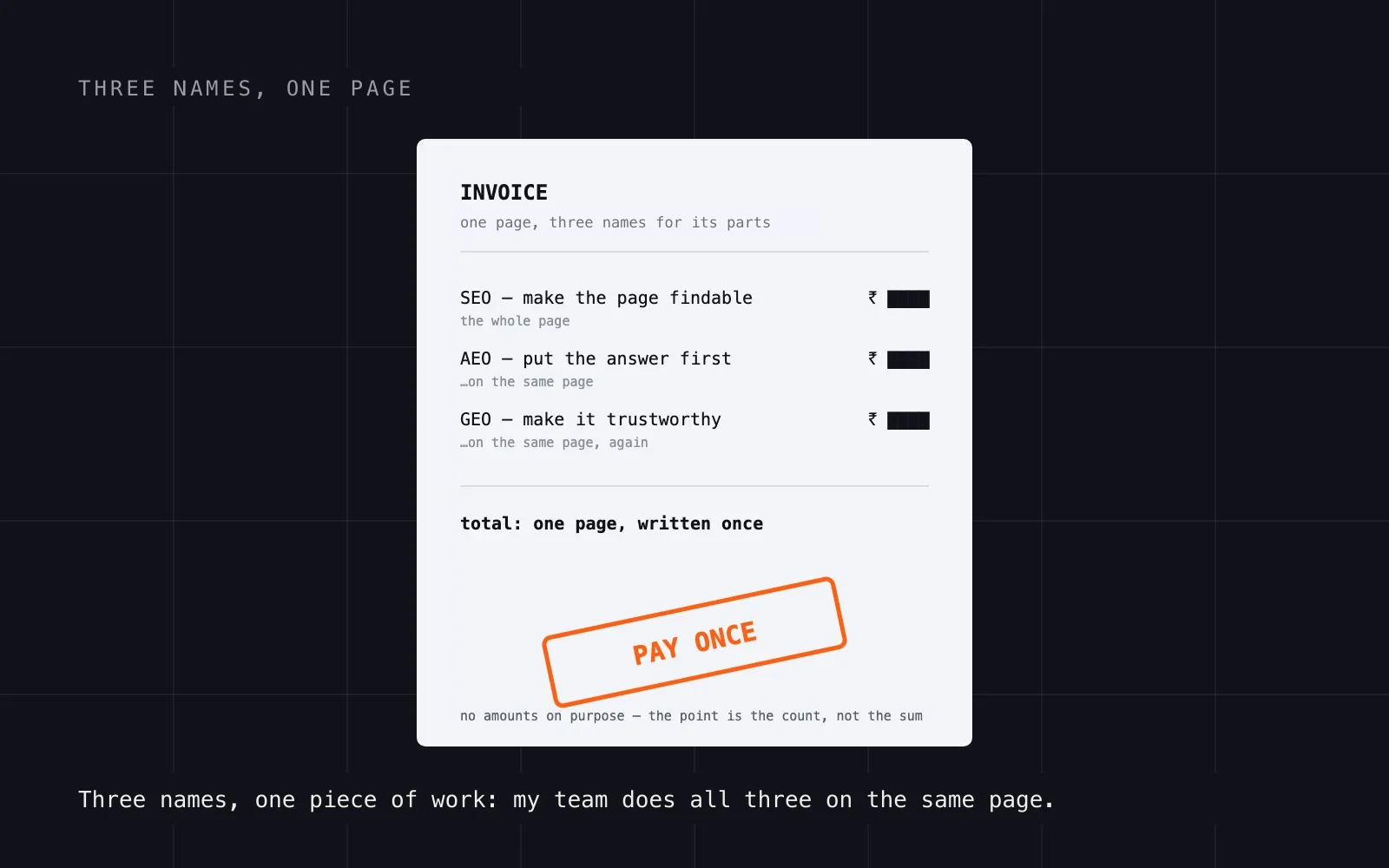
Three names, two extra rules, one piece of work. My team does all three on the same page, together.
Read next
The long versions of each name, the services this belongs to, and the tools from the steps.
- What is AEO? — answer engine optimisation, explained
- SEO vs AEO — one page, one extra rule
- What is AI SEO? — two meanings, one honest answer
- SEO services — done for you
- Freelance SEO consultant — the plan
- Free SEO checker
If you'd rather have someone do this
Run the free SEO checker on the page you'd most like to be cited — it shows which of the three you're actually missing, and it's usually the first. If you'd rather have one team with hundreds of websites completed do all three on one page, the SEO consultant page explains the plan and SEO services is where the team does the work and reports it monthly. The whole method, all nine questions, is in the AEO guide.
Questions
Questions this post answers
How do you optimise content for Google AI Overviews?
- The way Google's own guide describes: the ordinary ranking signals underneath, a crawlable page with the text in the HTML, people-first content that isn't a commodity — plus the answer first so the passage can be lifted. No special file or tag is needed; Google says it ignores them.
How do you optimise content for ChatGPT search?
- The same page works: one question, the answer in the first 40–60 words standing alone, proof underneath, and a page that is indexed and readable without JavaScript. ChatGPT reads the open web and cites the page that answers most directly; there is no submission form.
Does E-E-A-T matter for AI search?
- Yes — it is most of what "GEO" turns out to be. A named author with a track record, numbers with sources, a real example and a page that says what it doesn't cover are the signals a generative engine uses to pick one answer over ten similar ones, and they are the same signals a careful person uses.
How do you make content more trustworthy for AI search?
- Put a real person's name and page behind it, give every number a source and a year, include one real example rather than a general claim, and state the limits plainly. My team reads every AI-drafted line before it goes live, so each page carries all four signals an engine looks for.