
Comparison
Next.js vs WordPress for a small business site

WordPress runs your pages from an admin you log into. Next.js is code your developer builds and deploys.
Overview
What decides it
Next.js vs WordPress is decided by the work the site will do. A site made of pages that you or your staff edit belongs on WordPress, and it costs less to run. A site with logins, dashboards or links into your other systems belongs in Next.js. Speed on a phone can tip it towards Next.js as well.
You don't have to pick one before we talk.
If you already know your side, the WordPress and Next.js service pages explain how I build on each.
Comparison
WordPress or Next.js for a small business, question by question
Each row is a question that comes up on a first call, with the answer for each platform beside it.
| CRITERION | WordPress | Next.js |
|---|---|---|
| Can I edit pages myself? | ✓Yes, in Elementor or the block editor | ~Yes, once an admin panel or a CMS is built in; without one, a change is a code change |
| Accounts, logins and dashboards | ~Plugins cover the simpler cases | ✓Built as part of the app, on Node and MongoDB |
| Links into your other systems | ~Through a plugin, where one exists | ✓Written to fit the systems you already use |
| Speed on a phone | ~Quick on a thin theme, with every plugin checked first | ✓Pages arrive from the server as finished HTML |
| Can Google read every page? | ✓Yes | ✓Yes, when each public page is rendered on the server, which is how I build them |
| Hosting | ✓Any PHP host | ~Vercel, or a Node server you control; usually dearer than shared PHP hosting |
| Upkeep | ~Weekly updates, each after a fresh backup | ~Dependency updates a few times a year, done by a developer |
| Build cost for the same pages | ✓Lower | ~Higher, because you're paying for a codebase |
| What you hold at handover | ✓The WordPress admin and the files | ✓The repository and the runbook |
- You edit pages yourself
- Cost to build
- Cost to host
- Speed on a phone
- Accounts and dashboards
- Links into other systems
- Google reads every pageeven
- Upkeepeven
Why it matters
How I build on each one
On WordPress, the person changing the site is usually you. A new product goes up on a Monday. The opening hours change before a holiday. A blog post goes out when somebody finds time to write it, and none of it waits for a developer. I build those sites on a lightweight base theme. Each plugin adds its own files to every page, and a large image adds more, so I check every plugin before it goes on and keep the images small.
A Next.js build carries work behind the pages. Customers log in. Orders pass to another system. A dashboard shows figures that change through the day. I render every public page on the server, so a phone gets finished HTML on the first request and so does Google. That makes the code a little less convenient to write. I do it anyway, because I want the words on the screen before any JavaScript has loaded.
Integrations are the slowest part of a Next.js build to get right. Every outside system has its own edge cases, and most of them only show up once real data runs through. So each integration goes into the scope as its own line.
What the research says
How load time changes what mobile visitors do
Google measured real mobile visits, and Deloitte measured what a tenth of a second was worth across 37 brand sites. The green band is the load time Google calls good.
At 3.0 s a mobile visitor is +32% more likely to leave than at 1 s, as Google published it. Measure your page →
The rise after mobile pages got 0.1 seconds faster.
- Retail conversion rate8.4%
- Retail spend per order9.2%
- Travel conversion rate10.1%
These figures are other people’s research, quoted as published. Your own site’s numbers come from the free checks and the audit.
Upkeep, on both
Neither is free to keep. WordPress needs its updates every week. Next.js needs a developer a few times a year.

Case study
A hosting company on Next.js, a US firm on WordPress
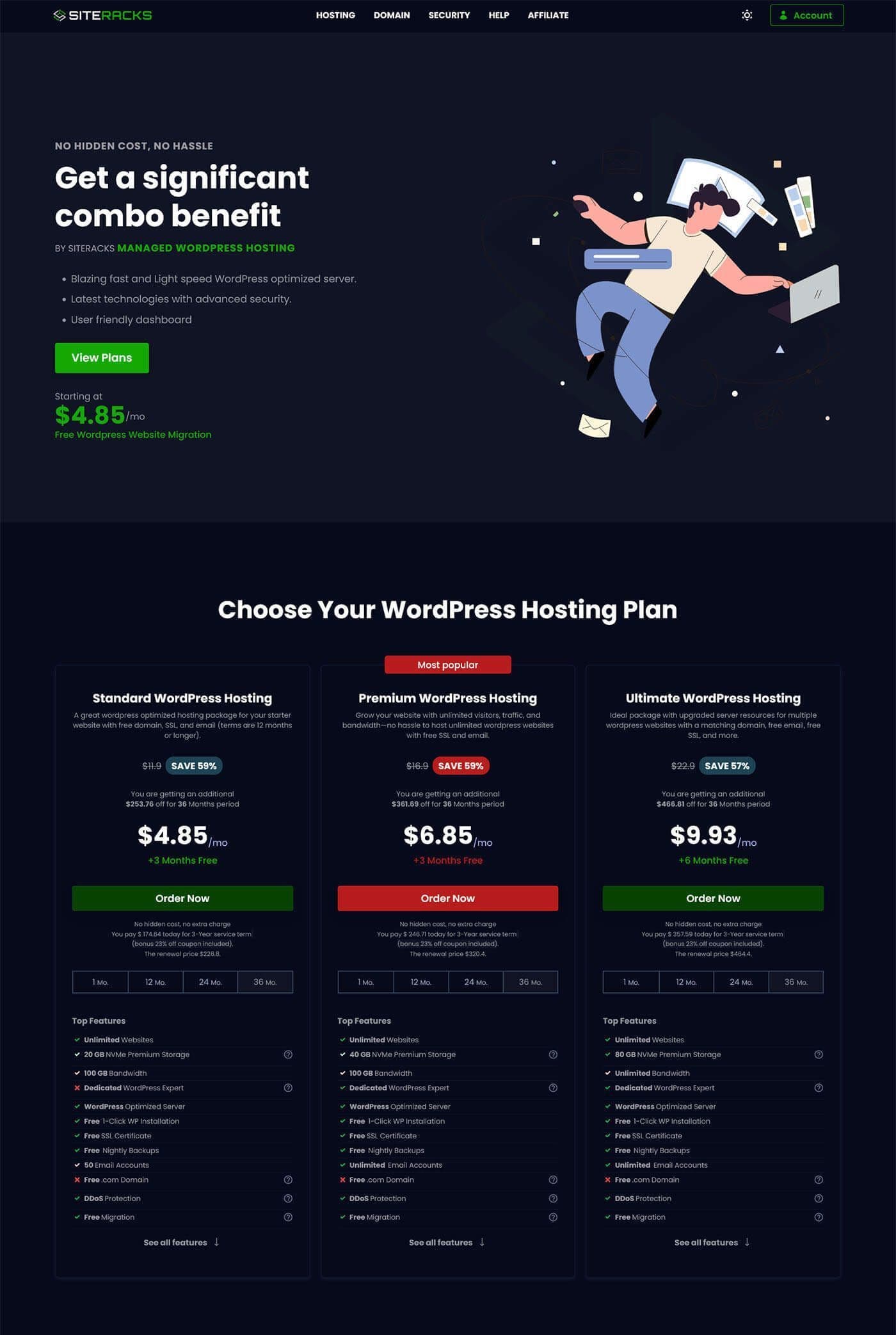
In 2024 I built SiteRacks Hosting for a US hosting company, in Next.js and React with MongoDB, deployed on AWS. Their review is on the project page.
The same year, Cornhusker Capital, a US company, got its site on WordPress with Elementor. Elementor lets the content be changed without touching code, and their review sits on the project page too.

Pricing
Next.js vs WordPress cost, to build and to keep
For the same set of pages, WordPress costs less to build. You are paying for a theme set up to your design. Next.js costs more up front, because the result is a codebase written for your site.
Hosting follows the same pattern. Any PHP host will run WordPress. Next.js runs on Vercel or on a Node server you control, and that usually costs more than shared PHP hosting.
Upkeep is the line to plan for. A care plan covers the WordPress updates, or someone on your team can take them on. For Next.js it is a developer on a retainer, or a team that already runs Node.
Prices depend on the scope, so every quote is a written list with each page, integration and migration on its own line. The pricing page shows how that list gets built.
Next step
Ask which one I'd build for you
Book a call and tell me about the business. You'll get my pick and the reasons behind it, whichever stack it turns out to be.
WordPress is so widely used. Isn't that reason enough to choose it?
- No, not on its own. Its reach does bring real advantages, such as a large choice of themes and plenty of developers who know the platform. The choice between WordPress and Next.js still rests on what your own site has to do, and that differs from one business to the next.
Is Next.js better than WordPress for speed?
- A Next.js page usually reaches a phone sooner, because the server sends finished HTML and only the interactive parts load as JavaScript. A WordPress site can be quick as well, on a light theme with sized images and a short list of plugins. For your current site, the free speed check gives a reading of where it stands today.
Can I change a Next.js site without a developer?
- Yes, you can edit a Next.js site yourself once an admin panel or a CMS is built into it, and that goes into the scope as its own line. Without one, every change to a Next.js page is a change to the code. If you plan to edit pages every week, tell me on the first call, because it changes what gets built.
Should I launch on WordPress if my product isn't built yet?
- Yes, WordPress can carry the business in the meantime, and the Next.js site is quoted as its own project once the product is ready. Every WordPress address then gets a redirect to its new page, so what the WordPress site earned on Google can carry over.
Is Next.js or WordPress better for SEO?
- Neither platform has an edge with Google when each page arrives as HTML with the words already in it, and a server-rendered Next.js page does that as well as a WordPress page. Rankings then come from the work done on each page. A clear title matters. So does how quickly the page opens on a phone.
Published · Updated